Is that slug doing you any favours?
The slug is the last part of a URL — the bit after the final slash that you chose. It shows up under the title in a results listing, it’s what people see when a link gets pasted into a message, and it’s one of the few things left that’s entirely under your control and still readable by a human being.
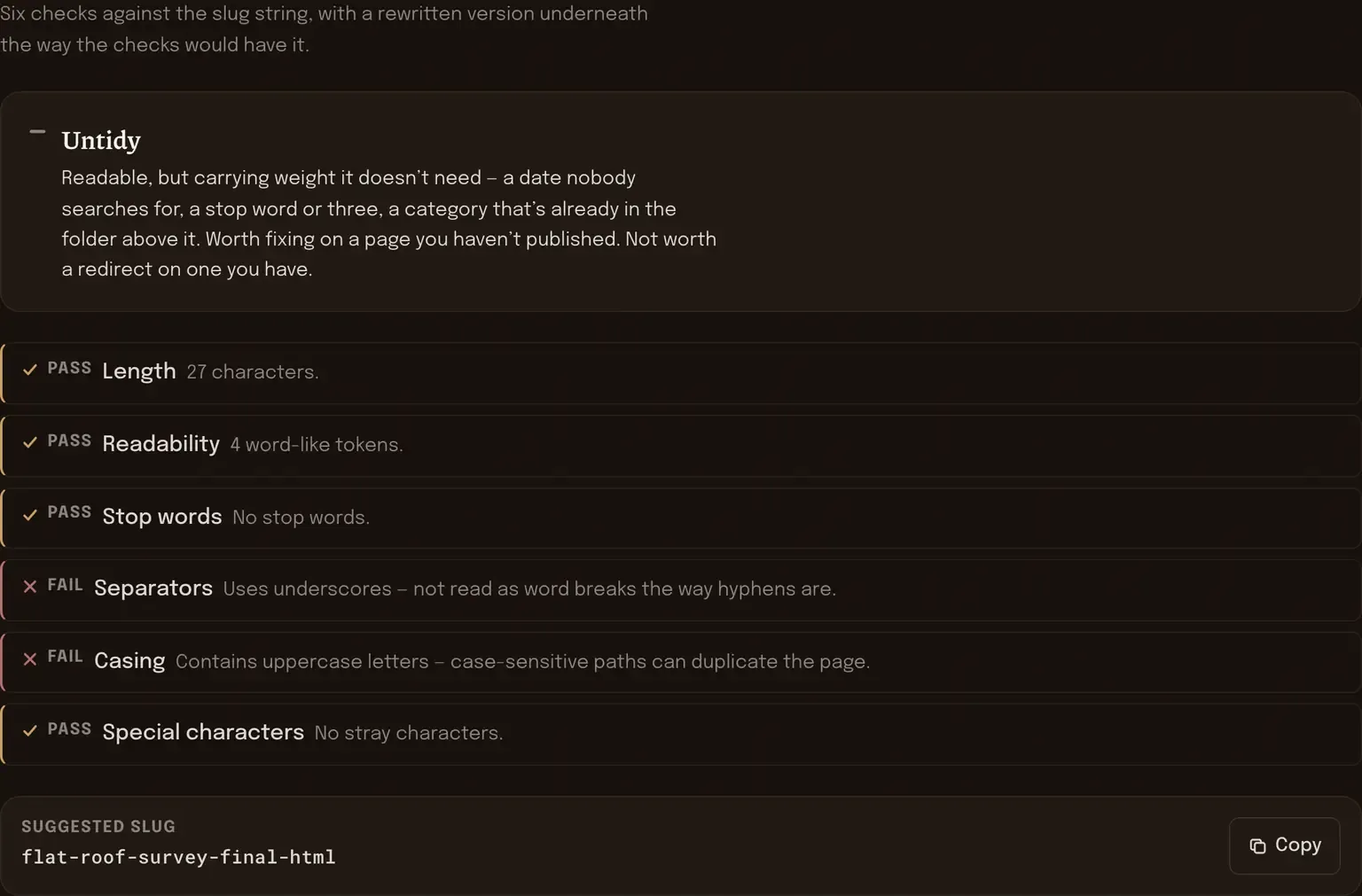
Paste a URL in and this grades the slug on six things: how long it is, whether it’s made of real words, whether it’s carrying stop words that add nothing, which separator it uses, whether there are capitals in it, and whether anything in it has to be escaped.
No URL yet. Paste one and the six checks appear.
What to change, and what to leave alone
The most important thing this tool can’t tell you is whether changing the slug is worth it. Changing a live URL means a 301 redirect, and every redirect is a small permanent tax — a hop for every visitor, a signal that has to pass through it, and one more line in a config file nobody will understand in three years. For a page that’s been live and linked to for a while, an untidy slug is almost always cheaper to keep than to fix.
For a page that isn’t published yet, fix all of it. Lowercase, hyphens rather than underscores, no dates unless the date is the point, no stop words, and the shortest form that still says what the page is. Prefer “flat-roof-survey-explained” to “how-to-understand-what-is-in-a-flat-roof-survey-report”.
Underscores are the one that surprises people. Hyphens get read as word separators; underscores historically didn’t, which means “flat_roof_survey” can be treated as one long token instead of three words. It’s a small effect, and an easy one to simply never have.
Capitals are a correctness problem more than a ranking one. Paths are case-sensitive on most servers, so /Guides/Survey and /guides/survey are two different pages as far as a crawler is concerned, and if both resolve you’ve created a duplicate without meaning to. Pick lowercase and enforce it at the server rather than in everyone’s habits.
Depth matters less than people assume. A slug three folders deep isn’t penalised for being three folders deep; it’s penalised when the folders are noise. /guides/roofing/flat-roof-survey earns its structure. /en/v2/pages/content/guides/roofing/flat-roof-survey does not.
Nothing is fetched
Worth being exact about what this does. It reads the URL as a string of characters and grades those characters. It never requests the address. Nothing is fetched, nothing is sent, and what you paste doesn’t leave this tab — which is why an unreleased path or an internal staging address is safe to check here.
Next to this one
[ found / missing ]
Meta tag and Open Graph preview
The slug is one line of a search result. Paste your head markup into that one to see the other two lines, and the canonical that governs them.
[ JSON-LD out ]
Schema generator
A slug describes a page to a person. JSON-LD describes it to a machine. This writes the second one.
Slugs, redirects and the rest of the plumbing
URL structure is cheap before launch and expensive afterwards, which makes it worth an opinion early rather than a migration later. That’s part of Technical SEO. Technical SEO basics covers the same ground for free if you’d rather read first.