How hard is this to read?
Three formulas, one underlying question
All three scores measure roughly the same two things: how long your sentences are, and how many syllables your words have. That’s it. They don’t know whether your argument holds or whether the jargon was necessary. What they’re genuinely good at is catching the sentence that ran away from you.
Paste text in and you get Flesch Reading Ease as a number out of 100, Flesch-Kincaid as a US school grade, and Gunning Fog as years of education. Underneath, the counts they’re derived from: words, sentences, syllables, average sentence length, and which sentences are the longest.
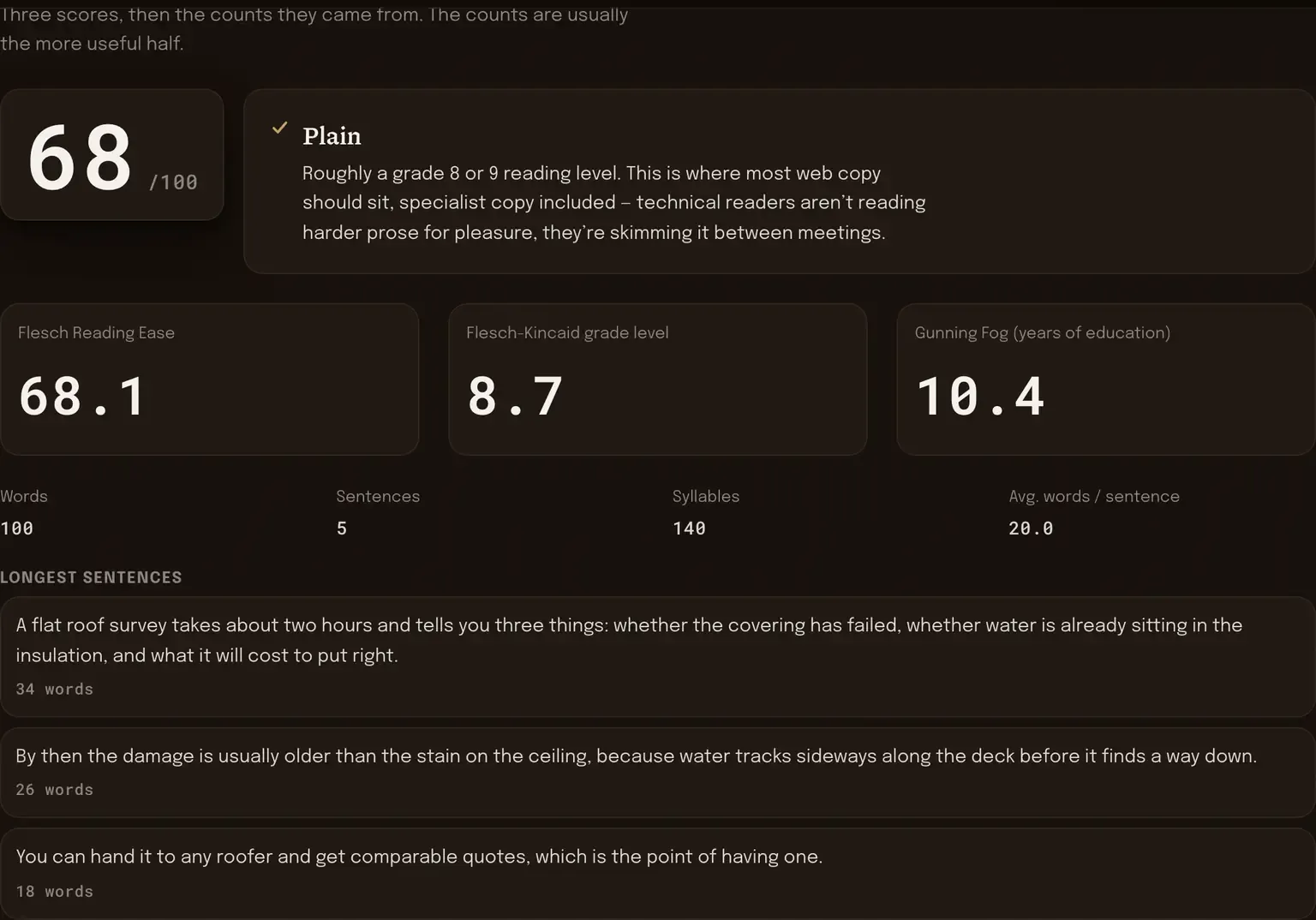
No text yet. Paste something in and the three scores, plus the counts behind them, appear.
Reading the score, and when to ignore it
Look at average sentence length before you look at any of the three scores. It’s the input that moves them most and the one you can act on this afternoon. An average over about 25 words means the score is telling you about your punctuation, not your vocabulary. Find the longest sentence in the list, find the conjunction sitting in the middle of it, and put a full stop there instead.
Syllables are the other input, and the one to be sceptical about. “Implementation” and “unbelievable” are both long words; only one of them is hard. The formulas can’t tell the difference. If your score is low and your sentences are already short, you’re being penalised for domain vocabulary your readers know perfectly well — which is a good reason to ignore the number.
The opposite trap is worse and more common: chopping sentences into fragments to push the score up. You can get any text to a Flesch 70 by deleting every subordinate clause, and what you’re left with reads like a form letter. The score is a smoke alarm, not a recipe.
What to actually do with a “heavy going” reading: split the three longest sentences, replace the nominalisations — “provide an assessment of” becomes “assess” — and cut the stacked qualifiers. Then score it again. Usually the number moves without a single word of the substance changing.
Worth knowing, for search specifically: nobody ranks you on a Flesch score. The reason readability matters at all is that a page you can lift a clean sentence out of is also a page that’s easy to read, and the reverse. AI readiness checker measures that first half directly.
Counting syllables is the only hard part of this, and your browser does it — the whole scorer is a few hundred lines of JavaScript running in this tab. Draft copy you haven’t published yet is safe to paste here. It isn’t transmitted, it isn’t stored, and there’s no server on my side that has ever seen it.
Two that go with it
[ four checks ]
AI readiness checker
Short sentences aren’t the same thing as a direct answer. That one checks whether the text says the thing outright, and says it near the top.
[ chars + pixels ]
SERP snippet preview
The same discipline, one line instead of six paragraphs. See where a title and description get cut.
Rewriting, at the scale of a site
One page you can fix yourself in twenty minutes. A library of them is a different job, and it’s what AI & Content Visibility is for. AI overviews, explained is the free background on why plain text started mattering more than it used to.