Can a machine answer from this page?
When an AI writes an answer, it’s pulling sentences out of pages that made those sentences easy to pull. That usually means the page said the thing outright, near the top, in a form that survives being lifted away from everything around it.
This checks four properties of the text you paste. Whether it answers inside the first 40 to 60 words. Whether it’s built as questions and their answers. Whether comparable facts sit in a structure something can read straight off. And whether the page names the things it’s about clearly enough to be recognised. It’s the same first pass I make on a real page, run on text you paste in.
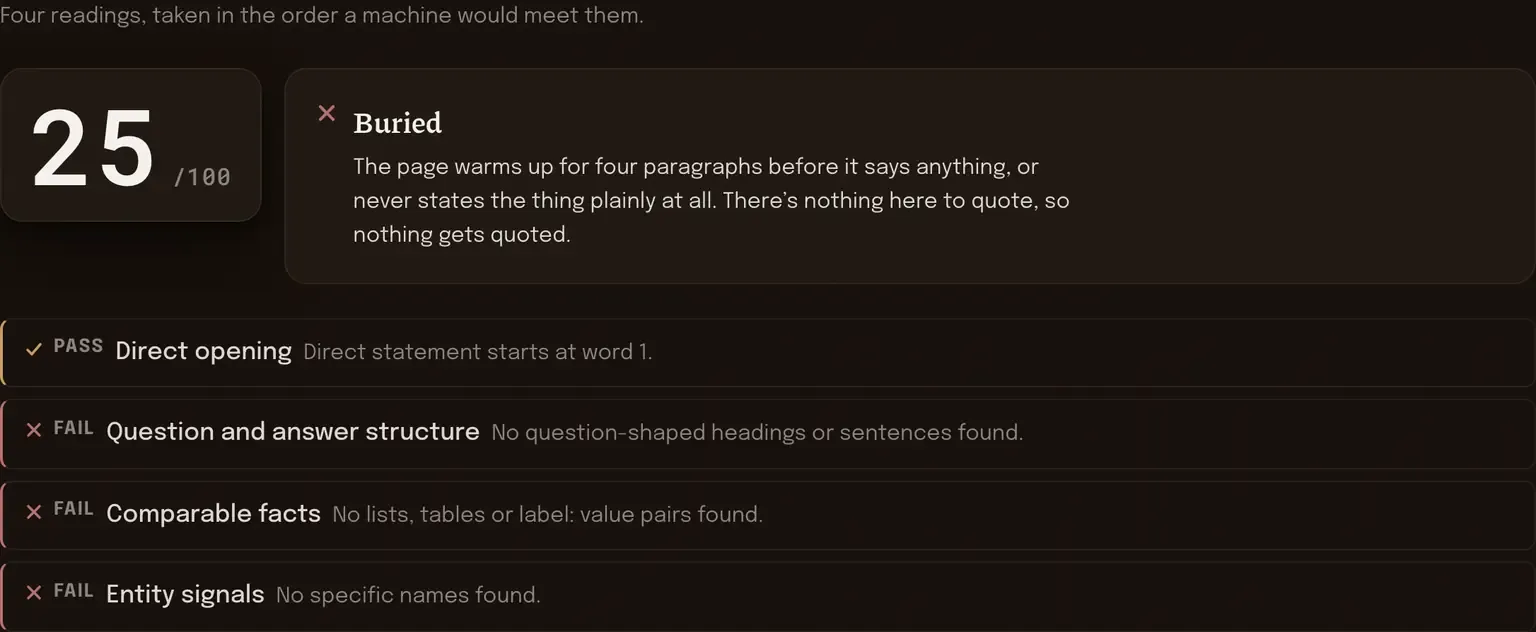
Nothing to read yet. Paste some text and the four checks fill in.
Reading the four checks
Start with the opening. The check reads the first 40 to 60 words and looks for a sentence that answers the question the page is named after. If it flags, the fix is usually not writing more — it’s moving a sentence you already wrote up to the top and cutting the run-up. “We get asked this a lot lately” is a run-up. “A sitemap tells a crawler which pages exist” is an answer.
The question-and-answer check looks for headings shaped like the thing a person would actually type, with the answer directly underneath. A page of headings like “Our approach” and “Why it matters” will flag. Rename them to the question and the answer stays exactly where it is.
The comparable-facts check is about lists and tables. If your page compares three options in prose, the comparison has to be parsed back out of sentences, and it often comes out wrong. Put the same three options in a table or a list with consistent labels and it reads straight off. This is the check most pages fail and the one that takes the least time to fix.
The entity check is the vaguest and the most consequential. It asks whether the page names what it’s about — the company, the place, the product, the standard — plainly, and more than once, instead of saying “we” and “our service” all the way down. If this flags on one page, edit the page. If it flags on every page you test, that’s a house-style problem and a job for AI & Content Visibility.
One more rule of thumb. A poor reading on a single page is a page problem. The same poor reading everywhere usually traces back to a template or an in-house style guide rather than to whoever wrote the words.
The text you paste stays in the box. The checks are JavaScript running in this tab, so the page you’re testing is never uploaded and never sent to me — which is also why the tool asks for the text itself rather than for the address of the page it came from.
Two that pair with this one
[ three indices ]
Readability scorer
A direct opening that takes forty words and three commas to get through isn’t direct. Run the same text through this for the sentence lengths behind the reading.
[ JSON-LD out ]
Schema generator
The entity check is about the words on the page. Structured data is the machine-readable version of the same claim. This writes it for you.
The same four checks, across everything you publish
Running this on one page tells you about one page. AI & Content Visibility is these checks applied to the whole library, plus the rewriting that follows. If you’d rather understand what changed in search before spending anything on it, AI overviews, explained covers it.